The Brigadier
The Darling Buds of MayThe Brigadier is a retired officer whose worn appearance and formal bearing make him one of Pop Larkin’s most distinctive friends. His visit to ask for help with a country gymkhana brings Pop’s generous, improvised hospitality into public view; their friendship continues through the event and into Pop’s later offer of a holiday in France. The Brigadier’s threadbare clothes, courteous reserve, and command of words such as “adamant” set him apart from the Larkins’ boisterous plenty, but also make him a quiet measure of Pop’s capacity for loyalty and kindness.
Identity and Introduction
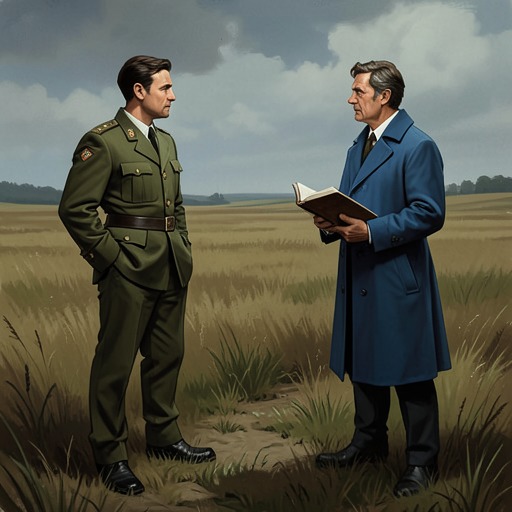
The Brigadier first approaches Pop’s yard as a visitor whom Montgomery Larkin recognizes from a distance. He appears as a straight, six-foot figure in an old tropical-alpaca suit bleached from yellowish to whitish fawn and seemingly flattened. Up close, the details sharpen the impression of prolonged wear: squares of paler material patch his elbows, the cuffs have been cut and sewn back, his socks are yellow, and his frayed hat sits behind exceptionally large white eyebrows. The comic precision of this portrait does not erase his erect bearing; the contrast between military posture and depleted clothing becomes his defining visual signature.
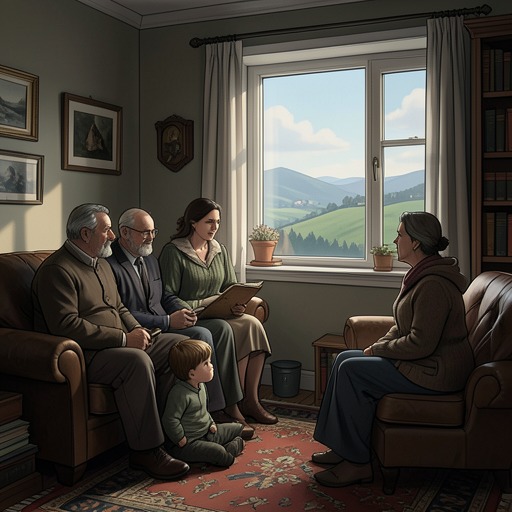
Pop greets him as “General!” and asks what he can do for him. The Brigadier answers, “Hail,” then calls Pop “Larkin,” preserving a formal, ceremonious manner even in the easy familiarity of their meeting. His style is restrained rather than effusive: when Pop offers him a drink, he initially refuses as a matter of minor politeness before accepting whisky-and-soda. The scene places him within the household’s unceremonious warmth without making him imitate it.
The Gymkhana and Mariette
The Brigadier arrives burdened by what he calls a “God-awful mess.” Pop guesses that women are involved, but the practical problem that emerges is a need for a venue for the gymkhana. Pop immediately offers the meadow, treating the request not as a negotiation but as a problem already solved: the grass needs cutting, and he will have it cut that week. His readiness matters particularly because Mariette is pregnant and the event, only a fortnight away, may be her last opportunity to ride the jumps before the baby comes. She loves jumping and has her heart set on horses; the Brigadier’s request therefore intersects with her personal hopes as well as his organizing difficulty.
The Brigadier does not press Pop for an answer or presume on the offer. He tells him not to let himself be rushed and insists that there is no need to decide immediately. Pop has already decided. Later, at dinner, the Brigadier checks whether Pop has told the children about the gymkhana. Pop realizes that he forgot, then announces it to the table while waving a dripping wing-bone. Mariette springs up and kisses him enthusiastically. The Brigadier’s prompt thus helps set in motion an occasion embraced by the whole household, while Pop’s willingness to host it turns a request into a family celebration.
Friendship and Character
The Brigadier’s relation with Pop rests on a contrast in temperament. Pop is expansive, informal, and quick to turn a visitor’s trouble into a practical offer; the Brigadier is cautious, ceremonious, and careful not to demand too much. Their differences are visible in the meadow exchange, where Pop’s breezy certainty meets the Brigadier’s concern not to rush him. They do not prevent closeness: Pop welcomes him into the house, shares drinks with him, and makes room for his concerns within family life.
The friendship also connects the Brigadier to Mariette and the wider Larkin household. At the dinner where the gymkhana is announced, he is present as part of the company rather than merely as an organizer passing through. Later, during the event, he tells Pop that Mariette is the only person with time to spare; in the pressure of modern life, he reflects, nobody has time. The comment gives the busy gathering a sober countercurrent. Even in the country, the scarcity of time reaches into ordinary life, and the Brigadier’s observation is less a complaint about one person than a bleak account of a hurried world.
Courtesy, Appearance, and Language
At the gymkhana, the Brigadier notices the time, sees that it is past noon, and says he must hurry back for a bite of cold. Pop invites him to the beer tent for a quick drink, but he refuses because Nellie will be waiting and says he will be adamant this time. The small exchange reveals his conscientiousness: he has somewhere he is expected, and despite Pop’s convivial pull he means to keep his word and go back.
Pop watches him leave with bemused admiration. The Brigadier’s shoelace is missing and has been replaced with packing string; his hair needs cutting, and his collar is even more frayed than before. Yet Pop’s attention settles on the word “adamant,” which seems to shine from the Brigadier and reminds him of people who can use such startling words. The moment is affectionate and comic, but it also makes the Brigadier’s verbal command a kind of dignity independent of his worn possessions. Pop envies the word, while the Brigadier uses it not to display status but to reinforce a modest promise.
The Brigadier’s sister, seen at the gymkhana, is described in beige shantung and a pink cloche hat, an appearance that makes her look like a clothes peg topped by a thimble. The detail situates him among the event’s visitors and family connections, but the Brigadier’s own characterization remains distinct: his shabby clothes are repeatedly noted, yet they coexist with self-possession and courtesy rather than reducing him to a figure of mere ridicule.
France and the Continuing Bond
Later, Pop encounters the Brigadier walking beneath an umbrella in July rain, wearing a military raincoat and carrying a grey string bag. Pop again sees how poorly he fares: even his usual mixture of erectness and patched, darned clothes now makes him look like a walking skeleton. The image recalls his earlier appearance at the farm, but the repeated details deepen the impression of hardship. Pop’s response is not simply to remark on it; he stops the Rolls-Royce and offers him a lift.
The Brigadier says he would rather walk if Pop does not mind. Pop accepts that preference, then proposes an alternative: France, where the Brigadier could get some sun, with a place for him in the Rolls and no charge for the return trip. The Brigadier asks quietly whether Pop truly means to take the car, and Pop says he intends to fly it across. The exchange ends with the offer still in motion, but it shows their friendship extending beyond the meadow and the gymkhana. Pop’s hospitality takes the form of concrete plans, while the Brigadier’s cautious question registers how large an invitation it is.
Narrative Significance
The Brigadier provides a counterpoint to the Larkins’ plentiful, noisy household. His patched elbows, string-repaired shoelace, frayed collar, and empty shopping bag stand against the abundance around Pop, yet the novel does not present him only as an emblem of poverty: he keeps appointments, observes social courtesies, and speaks with measured authority. His presence allows Pop’s generosity to appear through repeated acts rather than declarations, from making the meadow available to offering a place in the Rolls for a French holiday.
His episodes also connect public and private life. The gymkhana is a community occasion, but its origins lie in a personal request and its significance for Mariette’s chance to ride; the Brigadier’s reflection on time places that festive day against the pressures of modern life. In the later rain-soaked meeting, the same friendship narrows to a roadside offer and a question about whether Pop really means it. Across both moments, the Brigadier remains formally self-contained, while Pop answers that reserve with practical welcome.